
Many CEOs and sales leaders assume that if the pipeline is large enough, revenue will follow. But in many B2B companies, the opposite happens. The pipeline looks healthy. Activity levels appear strong. Forecasts seem reasonable.
Yet deals stall, forecasts slip, and revenue falls short.
The problem usually isn’t the market or the product. It’s much more than that.
Revenue Misses Are Costly
According to a 2026 Bain & Company report, while 91% of B2B leaders expected to hit their 2026 targets, 42% of them failed in 2025. The primary reason? A lack of a clear value proposition in a market where buyers are now obsessed with AI efficiency rather than just buying more software seats. It is essential that management, marketing, and sales communicate your value proposition in the best possible manner. Environments change, and this will affect your perceived value proposition. As a leader, you need to be aware of these changes quickly, so you have time to make the appropriate adjustments before it is too late.
Here are three specific, well-known examples of B2B companies that missed their numbers and the subsequent fallout.
1. Salesforce (CRM)
In April 2026, Salesforce saw a significant hit to its valuation following renewed investor anxiety over the long-term impact of AI on the traditional SaaS subscription model.
- Stock Price: The stock plummeted nearly 9% in a single day (April 23, 2026), closing at around $173. This contributed to a broader year-to-date loss of roughly 34%, significantly underperforming the tech sector.
- Cash Flow: While Salesforce maintains an “A+” profitability rating, investors are worried about margin pressure. The shift toward “Agentic AI” (like Salesforce Agentforce) is forcing a pivot from “per-seat” pricing to “per-outcome” or “per-conversation” pricing, which creates short-term revenue uncertainty.
- People: Salesforce has shifted from a “family” culture to an “efficiency” culture. Following massive layoffs in early 2023 (10% of staff), the company has remained lean. Recent misses have increased pressure on sales teams to pivot their entire pitch toward AI agents, leading to high-stress “commercial workflow redesigns.”
2. Snowflake (SNOW)
Snowflake, once the “darling” of B2B cloud data, faced a “perfect storm” of missed expectations between late 2024 and early 2026.
- Stock Price: Shares fell 18% in a single day after the company disclosed “material consumption headwinds.” By April 2026, the stock was trading near $140—50% below its 52-week high.
- Cash Flow: As a consumption-based business, Snowflake’s cash flow is volatile. The “miss” was driven by customers optimizing their storage (using “Iceberg Tables” to keep data outside Snowflake) and tiered pricing, which reduced revenue from their largest customers.
- People: The company saw a major leadership shakeup, including the sudden retirement of CEO Frank Slootman in 2024 and the replacement of its Chief Revenue Officer (CRO) in early 2026. For the rank-and-file, this has meant shifting from “selling more storage” to “selling AI computation,” a difficult transition for many veteran reps.
3. Zoom (ZM)
In February 2026, Zoom reported Q4 results that “beat” on revenue but “missed” on profit expectations and, more importantly, issued a very weak forecast.
- Stock Price: The stock plummeted following the earnings call. For long-term holders, the pain is severe; the stock is currently worth only a fraction of its pandemic-era peak.
- Cash Flow: Zoom is struggling with Customer Acquisition Cost (CAC). As enterprises move toward “all-in-one” bundles (like Microsoft Teams), Zoom has to spend more on R&D to build AI-driven features (like Zoom IQ) just to keep its current customers from leaving.
- People: Zoom famously “ended” the work-from-home era for its own employees by requiring office attendance, which caused cultural friction. The financial misses have led to a tighter focus on “Agentic AI” tools, leaving employees in legacy divisions feeling deprioritized.
Summary of the “B2B Miss” Pattern
| Impact Area | Typical Outcome of a “Miss” |
| Stock Price | Immediate double-digit drops (10–20%) due to “multiples compression” (investors stop seeing them as high-growth). |
| Cash Flow | Shift from growth reinvestment to stock buybacks to appease angry investors and stabilize share prices. |
| People | “Pivot fatigue.” Sales teams are told to stop selling “Features” and start selling “AI Outcomes” overnight, often leading to turnover. |
Financial Pressures Aren’t Limited to Public Companies
All companies experience market shifts that directly impact financial performance. Startups and early-stage companies often feel this most acutely due to limited access to capital—whether self-funded or backed by investors.
Changes in your value proposition show up first with customers and prospects. Buyers understand their problems, know the available alternatives, and will evaluate your solution against those options. Your sales and services teams see these changes firsthand, but they don’t always have the tools or structure to communicate what’s happening effectively.
Sales leadership needs clear visibility and actionable insights to respond quickly.
When these issues aren’t addressed, common symptoms emerge:
- Revenue becomes unpredictable
- Forecast accuracy declines
- Sales cycles lengthen
- Pipeline quality deteriorates
- Growth becomes difficult to scale
The Most Common Go-To-Market Mistakes
Across many organizations, several patterns consistently limit sales performance:
Leading With the Product Instead of the Business Problem
Sales teams often focus on features and capabilities rather than the business outcomes executives care about. Customers buy results, not products.
Weak Opportunity Qualification
Teams pursue opportunities that lack:
- Real urgency
- Budget alignment
- Executive sponsorship
- Clear decision authority
This inflates pipeline but reduces forecast reliability.
Poor Alignment With the Buyer’s Decision Process
Many sales processes are built around how companies want to sell, not how customers actually buy. In complex B2B environments, decisions involve multiple stakeholders and approval steps that are often underestimated.
Over Reliance on “Hero Salespeople”
A small percentage of reps generate the majority of revenue. This creates risk and limits scalability. Growth should come from a repeatable system—not individual heroics.
What High-Performing Sales Organizations Do Differently
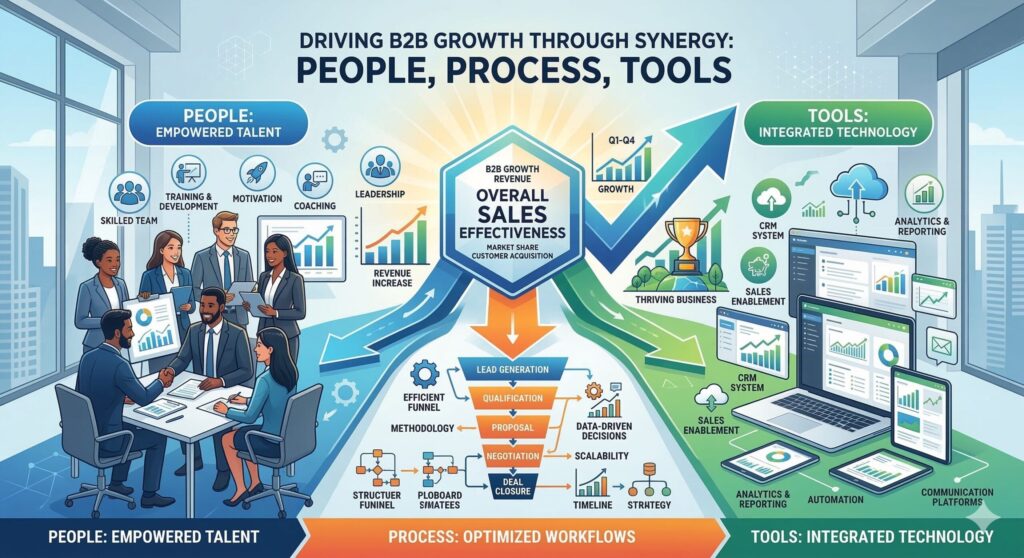
Companies that achieve consistent, predictable growth focus on improving Overall Sales Effectiveness. They prioritize a few key indicators:
Pipeline Quality
Not just volume—but qualified opportunities with real buying intent.
Win Rate
The ability to consistently convert opportunities into customers.
Sales Velocity
How efficiently opportunities move through the buying process.
When these improve, revenue performance typically follows.
Why This Matters to CEOs and Sales Leaders
Sales effectiveness is not just a sales issue—it’s a growth issue.
Organizations that actively measure and improve it often see:
- Improved win rates
- Shorter sales cycles
- Stronger pipeline conversion
- More reliable forecasts
In many cases, this results in 10–30% more revenue without increasing headcount.
A Question Every Executive Should Ask
If your company is pursuing growth, consider:
Do we truly understand how effectively our sales organization converts market opportunity into revenue?
For many leadership teams, the answer isn’t as clear as it should be.
Where Many Organizations Start
The first step is a structured assessment across key areas:
- Pipeline quality and opportunity management
- Sales process alignment with buyer behavior
- Win/loss patterns
- Sales cycle efficiency
- Sales team execution consistency
This typically reveals where the greatest performance gains can be achieved.
Final Thought
Sustainable growth doesn’t come from pushing sales teams harder. It comes from building a system that consistently converts opportunity into revenue.
You must clearly understand:
- The problem you solve
- How your teams communicate value, differentiation, and ROI
Organizations that focus on Overall Sales Effectiveness recognize market changes earlier and respond with clarity and precision—turning sales from an unpredictable activity into a repeatable revenue engine.
How effective is your sales organization? Click here to get your Overall Sales Effectiveness Score.