Author: Gregory Miller

  • Accurate Forecasting in B2B Sales

    Why Most Forecasts Fail — And What Sales Leaders Must Fix


    Forecasting Should Not Be Guesswork

    In many B2B organizations, forecasting is still driven by rep optimism instead of measurable customer commitment.

    “The customer seems interested.”

    “We feel good about this deal.”

    “I think it’s going to close.”

    Unfortunately, that is not forecasting.

    That is hope.

    At Enabling Sales LLC, we believe forecasting accuracy is one of the clearest indicators of Overall Sales Effectiveness.

    Forecasting is not simply a reporting exercise for leadership meetings.

    It is a direct reflection of:

    • Sales process execution
    • Buying-process validation
    • Opportunity qualification
    • Pipeline discipline
    • Coaching effectiveness
    • CRM data integrity
    • Sales leadership accountability

    When an organization consistently misses its forecasts, it rarely has just a forecasting problem—it has a execution problem.

    They typically have:

    • weak qualification,
    • inconsistent process execution,
    • poor pipeline hygiene,
    • and limited visibility into how customers actually buy.

    Executive Reality: Customers Do Not Buy According to Your CRM

    One of the biggest forecasting failures in B2B sales is assuming opportunities move according to internal sales stages.

    They do not.

    Customers buy according to:

    • Business priorities
    • Budget cycles
    • Executive alignment
    • Procurement requirements
    • Technical validation
    • Internal politics
    • Risk mitigation
    • Organizational urgency

    A forecast becomes unreliable the moment a salesperson is forecasting based on their internal sales process instead of the customer’s buying process.


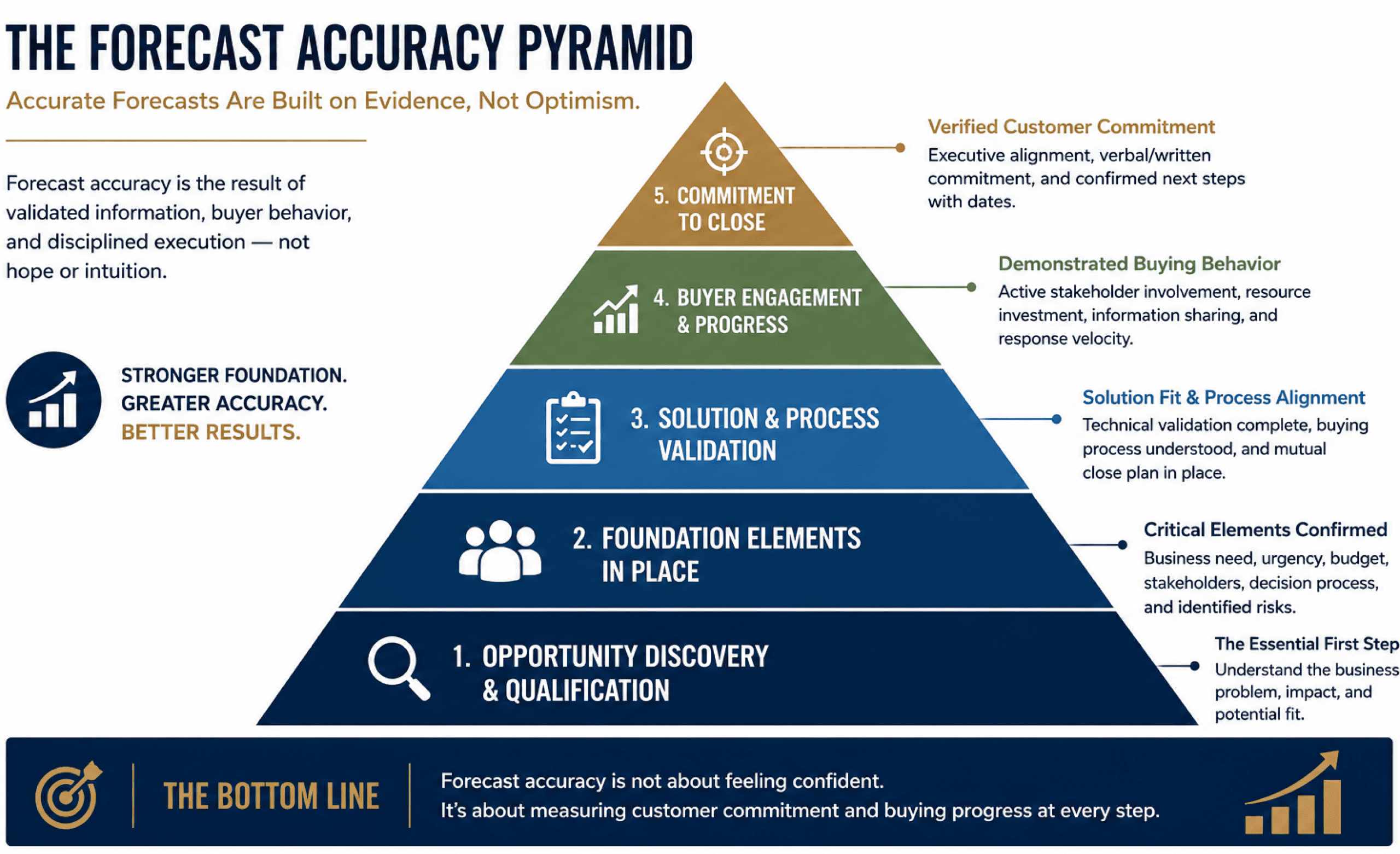
    Foundational Layers for Forecasting Accuracy

    1. CRM Hygiene
    2. Qualification Discipline
    3. Buying Process Validation
    4. Stakeholder Alignment
    5. Executive Sponsorship
    6. Customer Urgency

    What Sales Reps Must Validate for Accurate Forecasting

    1. A Real Business Problem Exists

    The customer must have a measurable business issue that matters enough to fund and prioritize.

    If the problem lacks urgency or executive visibility, the deal is not forecastable.

    Leadership Question: Is this initiative important enough for the customer to act now?


    2. The Buying Process Is Understood

    Reps must understand:

    • How decisions are made
    • Who approves purchases
    • Procurement requirements
    • Legal and security review processes
    • Budget approval paths
    • Fiscal timing constraints

    Most late-stage forecast misses occur because the customer’s internal approval process was never validated.


    3. Stakeholders Are Identified

    Single-threaded opportunities create forecasting risk.

    Sales reps must identify:

    • Economic buyers
    • Technical buyers
    • Functional leaders
    • Procurement teams
    • Executive sponsors
    • Internal champions

    Hidden stakeholders create hidden risk.


    4. Budget Is Confirmed

    Interest does not equal funding.

    Forecastable opportunities have:

    • Defined budgets
    • Approved funding
    • Confirmed fiscal alignment
    • Clear purchasing authority

    Without budget validation, forecast confidence drops dramatically.


    5. Technical Validation Is Complete

    Many opportunities fail late because technical concerns emerge too late in the process.

    Forecast accuracy improves when:

    • Solution fit is validated
    • Security reviews are addressed
    • Integration requirements are confirmed
    • Implementation expectations are aligned

    Buying Behavior Matters More Than Rep Sentiment

    At Enabling Sales LLC, we believe customer engagement behavior is one of the strongest indicators of deal health.

    Healthy opportunities typically include:

    • Executive participation
    • Fast response times
    • Multiple engaged stakeholders
    • Shared internal information
    • Requests for implementation planning
    • Mutually agreed next steps

    Weak engagement is often a more accurate predictor of risk than anything entered into the CRM.


    Forecast Risk Indicators

    GREEN FLAGS

    • Multiple stakeholders engaged
    • Budget confirmed
    • Executive sponsor active
    • Mutual close plan exists
    • Fast customer responsiveness

    RED FLAGS

    • Single contact opportunity
    • No urgency
    • No budget validation
    • Slipping close dates
    • Incomplete technical review
    • No executive involvement

    CRM Discipline Drives Forecast Reliability

    Forecasting accuracy is impossible without disciplined opportunity management.

    Sales leadership must enforce:

    • Stage exit criteria
    • Realistic close dates
    • Next-step accountability
    • Pipeline inspection cadence
    • Consistent opportunity updates
    • Forecast review discipline

    Garbage CRM data produces garbage forecasts.


    Forecasting Is an Organizational Capability

    Too many companies rely on “hero reps” who are naturally good at forecasting.

    That approach does not scale.

    Accurate forecasting should come from:

    • Structured qualification
    • Defined buying-process checkpoints
    • Coaching accountability
    • Pipeline inspection rigor
    • Measurable buying signals
    • Executive-level visibility

    At Enabling Sales LLC, we help organizations build forecasting systems that improve:

    • Predictability
    • Revenue visibility
    • Pipeline health
    • Sales execution
    • Coaching effectiveness
    • Executive confidence

    Because accurate forecasting is not about optimism.

    It is about measuring customer commitment.

    And organizations that master forecasting discipline gain something every executive wants: Predictable Revenue Growth


    About Enabling Sales LLC

    Enabling Sales LLC helps organizations improve overall sales effectiveness through:

    • Sales process optimization
    • Forecasting accuracy improvement
    • Pipeline analytics
    • Sales coaching frameworks
    • CRM discipline
    • Sales leadership enablement
    • Executive visibility systems
    • Data-driven sales management with Salez1.

    Our focus is simple:

    We Help B2B Business Owners and Sales Leaders Achieve Overall Sales Effectiveness.

    Learn More

    www.enablingsales.com
    Click to show encoded email & phone

  • Why Most B2B Organizations Miss Their Revenue Targets – Even With a Full Pipeline

    Many CEOs and sales leaders assume that if the pipeline is large enough, revenue will follow. But in many B2B companies, the opposite happens. The pipeline looks healthy. Activity levels appear strong. Forecasts seem reasonable.

    Yet deals stall, forecasts slip, and revenue falls short.

    The problem usually isn’t the market or the product. It’s much more than that.

    Revenue Misses Are Costly

    According to a 2026 Bain & Company report, while 91% of B2B leaders expected to hit their 2026 targets, 42% of them failed in 2025. The primary reason? A lack of a clear value proposition in a market where buyers are now obsessed with AI efficiency rather than just buying more software seats. It is essential that management, marketing, and sales communicate your value proposition in the best possible manner. Environments change, and this will affect your perceived value proposition. As a leader, you need to be aware of these changes quickly, so you have time to make the appropriate adjustments before it is too late.

    Here are three specific, well-known examples of B2B companies that missed their numbers and the subsequent fallout.


    1. Salesforce (CRM)

    In April 2026, Salesforce saw a significant hit to its valuation following renewed investor anxiety over the long-term impact of AI on the traditional SaaS subscription model.

    • Stock Price: The stock plummeted nearly 9% in a single day (April 23, 2026), closing at around $173. This contributed to a broader year-to-date loss of roughly 34%, significantly underperforming the tech sector.
    • Cash Flow: While Salesforce maintains an “A+” profitability rating, investors are worried about margin pressure. The shift toward “Agentic AI” (like Salesforce Agentforce) is forcing a pivot from “per-seat” pricing to “per-outcome” or “per-conversation” pricing, which creates short-term revenue uncertainty.
    • People: Salesforce has shifted from a “family” culture to an “efficiency” culture. Following massive layoffs in early 2023 (10% of staff), the company has remained lean. Recent misses have increased pressure on sales teams to pivot their entire pitch toward AI agents, leading to high-stress “commercial workflow redesigns.”

    2. Snowflake (SNOW)

    Snowflake, once the “darling” of B2B cloud data, faced a “perfect storm” of missed expectations between late 2024 and early 2026.

    • Stock Price: Shares fell 18% in a single day after the company disclosed “material consumption headwinds.” By April 2026, the stock was trading near $140—50% below its 52-week high.
    • Cash Flow: As a consumption-based business, Snowflake’s cash flow is volatile. The “miss” was driven by customers optimizing their storage (using “Iceberg Tables” to keep data outside Snowflake) and tiered pricing, which reduced revenue from their largest customers.
    • People: The company saw a major leadership shakeup, including the sudden retirement of CEO Frank Slootman in 2024 and the replacement of its Chief Revenue Officer (CRO) in early 2026. For the rank-and-file, this has meant shifting from “selling more storage” to “selling AI computation,” a difficult transition for many veteran reps.

    3. Zoom (ZM)

    In February 2026, Zoom reported Q4 results that “beat” on revenue but “missed” on profit expectations and, more importantly, issued a very weak forecast.

    • Stock Price: The stock plummeted following the earnings call. For long-term holders, the pain is severe; the stock is currently worth only a fraction of its pandemic-era peak.
    • Cash Flow: Zoom is struggling with Customer Acquisition Cost (CAC). As enterprises move toward “all-in-one” bundles (like Microsoft Teams), Zoom has to spend more on R&D to build AI-driven features (like Zoom IQ) just to keep its current customers from leaving.
    • People: Zoom famously “ended” the work-from-home era for its own employees by requiring office attendance, which caused cultural friction. The financial misses have led to a tighter focus on “Agentic AI” tools, leaving employees in legacy divisions feeling deprioritized.

    Summary of the “B2B Miss” Pattern

    Impact AreaTypical Outcome of a “Miss”
    Stock PriceImmediate double-digit drops (10–20%) due to “multiples compression” (investors stop seeing them as high-growth).
    Cash FlowShift from growth reinvestment to stock buybacks to appease angry investors and stabilize share prices.
    People“Pivot fatigue.” Sales teams are told to stop selling “Features” and start selling “AI Outcomes” overnight, often leading to turnover.

    All companies experience market shifts that directly impact financial performance. Startups and early-stage companies often feel this most acutely due to limited access to capital—whether self-funded or backed by investors.

    Changes in your value proposition show up first with customers and prospects. Buyers understand their problems, know the available alternatives, and will evaluate your solution against those options. Your sales and services teams see these changes firsthand, but they don’t always have the tools or structure to communicate what’s happening effectively.

    Sales leadership needs clear visibility and actionable insights to respond quickly.

    When these issues aren’t addressed, common symptoms emerge:

    • Revenue becomes unpredictable
    • Forecast accuracy declines
    • Sales cycles lengthen
    • Pipeline quality deteriorates
    • Growth becomes difficult to scale

    The Most Common Go-To-Market Mistakes

    Across many organizations, several patterns consistently limit sales performance:

    Leading With the Product Instead of the Business Problem

    Sales teams often focus on features and capabilities rather than the business outcomes executives care about. Customers buy results, not products.

    Weak Opportunity Qualification

    Teams pursue opportunities that lack:

    • Real urgency
    • Budget alignment
    • Executive sponsorship
    • Clear decision authority

    This inflates pipeline but reduces forecast reliability.

    Poor Alignment With the Buyer’s Decision Process

    Many sales processes are built around how companies want to sell, not how customers actually buy. In complex B2B environments, decisions involve multiple stakeholders and approval steps that are often underestimated.

    Over Reliance on “Hero Salespeople”

    A small percentage of reps generate the majority of revenue. This creates risk and limits scalability. Growth should come from a repeatable system—not individual heroics.


    What High-Performing Sales Organizations Do Differently

    Companies that achieve consistent, predictable growth focus on improving Overall Sales Effectiveness. They prioritize a few key indicators:

    Pipeline Quality

    Not just volume—but qualified opportunities with real buying intent.

    Win Rate

    The ability to consistently convert opportunities into customers.

    Sales Velocity

    How efficiently opportunities move through the buying process.

    When these improve, revenue performance typically follows.


    Why This Matters to CEOs and Sales Leaders

    Sales effectiveness is not just a sales issue—it’s a growth issue.

    Organizations that actively measure and improve it often see:

    • Improved win rates
    • Shorter sales cycles
    • Stronger pipeline conversion
    • More reliable forecasts

    In many cases, this results in 10–30% more revenue without increasing headcount.


    A Question Every Executive Should Ask

    If your company is pursuing growth, consider:

    Do we truly understand how effectively our sales organization converts market opportunity into revenue?

    For many leadership teams, the answer isn’t as clear as it should be.


    Where Many Organizations Start

    The first step is a structured assessment across key areas:

    • Pipeline quality and opportunity management
    • Sales process alignment with buyer behavior
    • Win/loss patterns
    • Sales cycle efficiency
    • Sales team execution consistency

    This typically reveals where the greatest performance gains can be achieved.


    Final Thought

    Sustainable growth doesn’t come from pushing sales teams harder. It comes from building a system that consistently converts opportunity into revenue.

    You must clearly understand:

    • The problem you solve
    • How your teams communicate value, differentiation, and ROI

    Organizations that focus on Overall Sales Effectiveness recognize market changes earlier and respond with clarity and precision—turning sales from an unpredictable activity into a repeatable revenue engine.

  • Why B2B CEOs and Owners Should Care About Overall Sales Effectiveness

    For most B2B companies, sales is the largest investment made to drive growth. Salaries, commissions, marketing programs, sales technology, training, and leadership all represent significant costs. CEO’s should care about overall sales effectiveness because these expenses can only deliver results if the sales process works efficiently. Yet many CEOs and owners cannot clearly answer a simple question:

    “Is our sales organization operating as an efficient revenue engine—or are we just hoping deals close?”

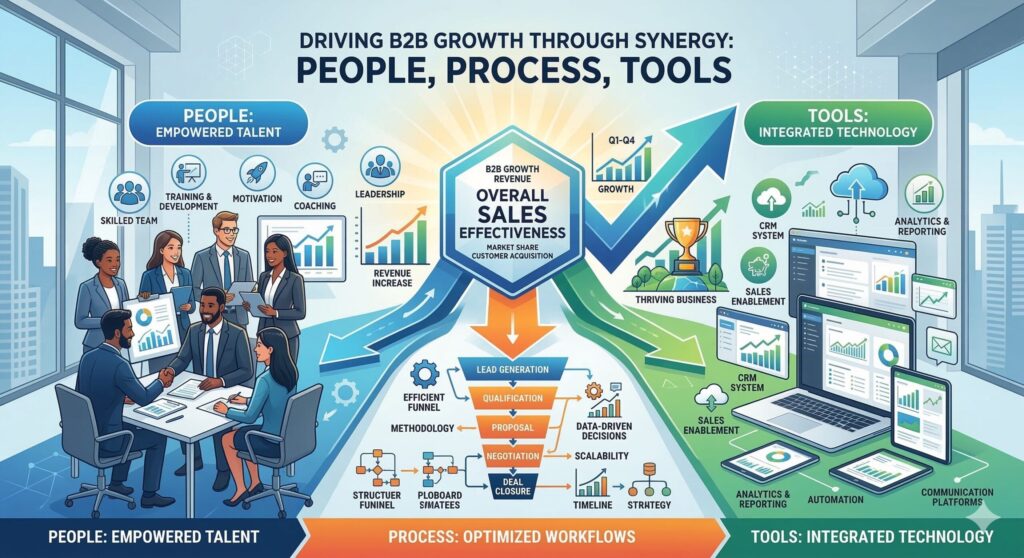
    Why B2B CEOs and Owners Care About Overall Sales Effectiveness image

    This is why Overall Sales Effectiveness matters.

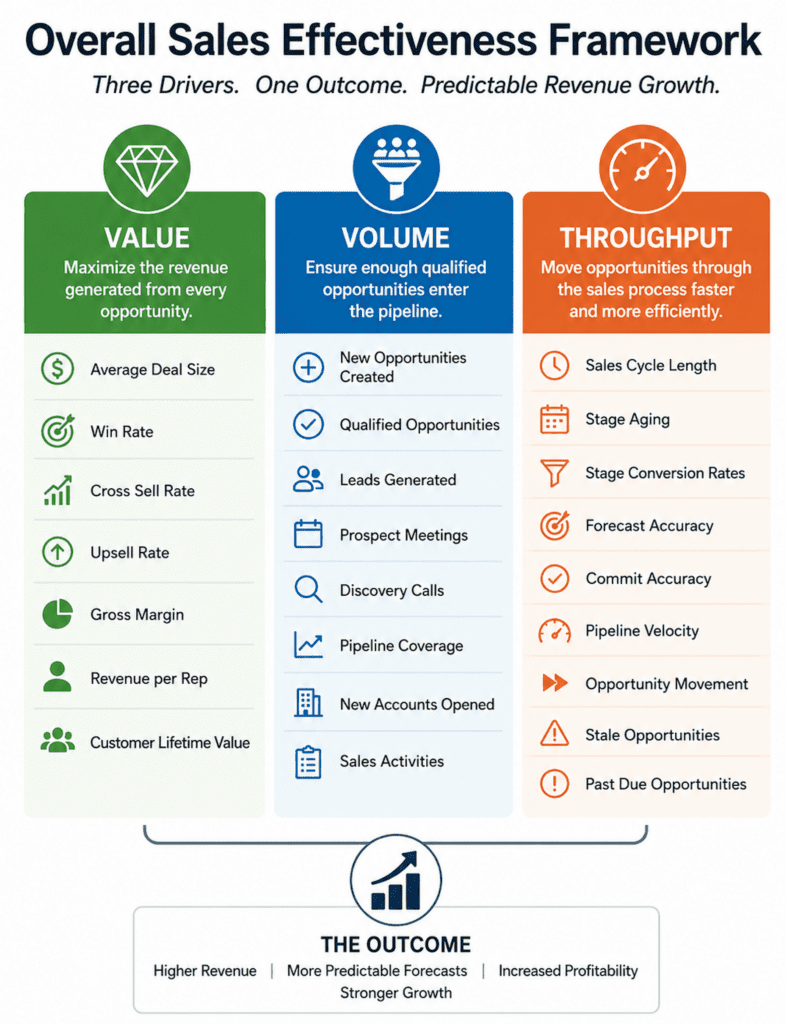
    Overall Sales Effectiveness is the ability of a company to consistently convert market opportunities into predictable revenue by aligning people, processes, tools (data, and technology) across the sales organization. When measured and managed properly, it becomes the operating system for revenue growth.

    Revenue Predictability vs. Revenue Hope

    Many B2B companies operate with a level of uncertainty around revenue performance. Forecasts change, deals slip, pipelines fluctuate, and results often depend on a few top performers.

    From a CEO’s standpoint, the issue is not just missing a number. The real problem is lack of predictability.

    Overall Sales Effectiveness introduces discipline and visibility into the revenue process. By measuring pipeline health, opportunity progression, win rates, and sales velocity, leadership can determine whether the company is on track to meet revenue goals well before the quarter ends.

    Instead of reacting to surprises, leadership can manage the outcome.

    Turning Sales Investment into Return

    Sales organizations are expensive. Hiring additional salespeople is often the default solution when growth slows, but hiring alone rarely fixes underlying problems.

    Overall Sales Effectiveness answers the question every CEO should be asking:

    “Are we getting the full return on our sales investment?”

    In many organizations, the answer is no. Research consistently shows that salespeople spend a large portion of their time on non-selling activities such as administrative work, internal meetings, and searching for information. Improving sales effectiveness helps reclaim this lost capacity, allowing companies to generate more revenue without increasing headcount.

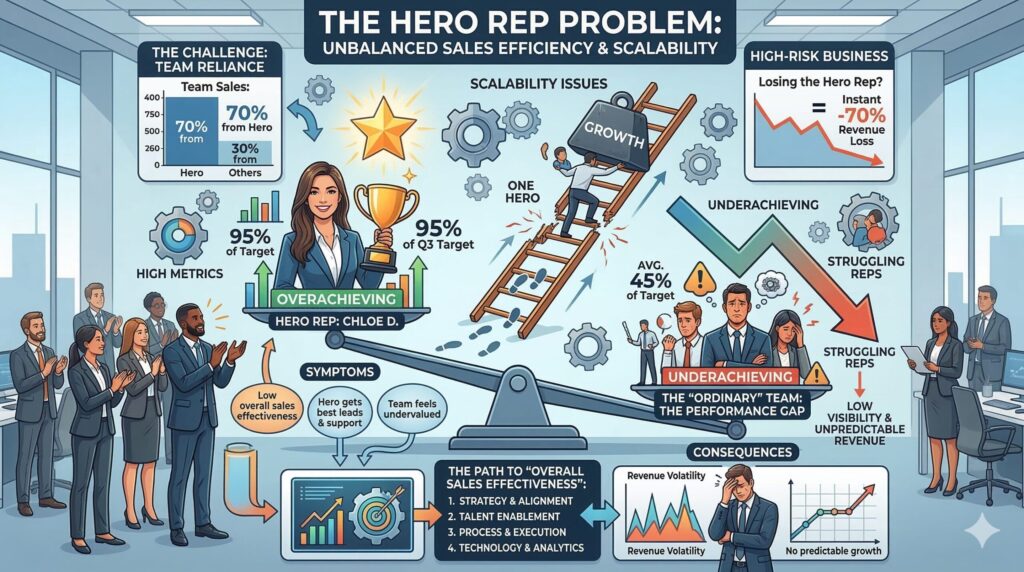
    The Hidden Risk: The Hero Rep Problem

    Many sales organizations depend heavily on a small number of high-performing salespeople. It is common for 20–30% of the sales team to generate the majority of revenue.

    While top performers are valuable, relying on them creates risk. If one of these individuals leaves the company, retires, or changes roles, revenue can decline quickly.

    Overall Sales Effectiveness focuses on creating a repeatable sales system that improves the performance of the entire team—especially the middle group of sales reps. When sales success is driven by a process rather than individual heroics, growth becomes far more scalable and stable.

    The Hero Rep Problem Image
    Is your organization relying on those few “Hero Reps” to make your number? With Overall Sales Effectiveness, you can turn “Underachieving” and “Ordinary” reps into Heros too

    Identifying Problems Before Revenue Declines

    One of the greatest benefits of Overall Sales Effectiveness is its ability to act as an early warning system.

    By monitoring key metrics such as pipeline coverage, win rates, deal progression, and sales cycle length, leadership can identify issues before they impact revenue.

    For example:

    • A decline in pipeline creation may signal future revenue shortfalls.
    • Longer sales cycles may indicate problems with value messaging or buyer alignment.
    • Deals stalled in late stages may reveal negotiation or approval barriers.

    With the right metrics in place, CEOs can address problems months before they appear in financial results.

    Aligning the Entire Organization Around Revenue

    Sales effectiveness is not just a sales department issue. It requires alignment across the entire organization.

    Marketing must generate qualified opportunities. Product teams must deliver solutions that create measurable value. Finance must ensure that pricing and margins support growth objectives. Sales leadership must ensure that opportunities move through the pipeline effectively.

    Overall Sales Effectiveness provides a common set of metrics and insights that align these groups around one goal: converting market opportunity into profitable revenue.

    Enabling Strategic Decision Making

    CEOs make decisions every day about where to invest resources. Should the company hire more salespeople? Enter new markets? Expand product offerings?

    Without clear sales effectiveness data, these decisions are based largely on assumptions.

    With the right metrics in place, leadership can determine:

    • Which markets produce the highest win rates
    • Which products generate the most profitable deals
    • Where sales cycles are slowing
    • Where pipeline generation is strongest

    This information allows CEOs to allocate resources where they will produce the greatest return.

    The Bottom Line

    B2B CEOs and owners should care about Overall Sales Effectiveness because it determines whether the company’s revenue growth is predictable, scalable, and sustainable.

    Organizations that manage sales effectiveness well typically see improvements in win rates, pipeline conversion, and sales velocity—often producing 10–30% revenue improvement without increasing sales headcount.

    But the true value goes beyond percentage increases.

    Overall Sales Effectiveness transforms sales from an unpredictable activity into a repeatable revenue engine—one that leadership can measure, manage, and scale with confidence.

    For CEOs responsible for driving growth, there are few capabilities more important. 

    Is your entire sales organization operating at a high level of Overall Sales Effectiveness? Click here to take a quick 12-question assessment and find out.

  • The Hawthorne Effect and Sales Team Productivity


    The Hawthorne studies from the 1920s demonstrate how observation increases B2B sales productivity

    There’s a fascinating concept from behavioral science called the Hawthorne Effect: This effect has been shown to generate immediate boosts in B2B sales productivity for organizations. The potential for increased productivity in B2B sales can be observed right away when interventions are strategically applied.

    People tend to improve their performance simply because they know they are being observed or measured. Originally discovered during workplace productivity studies in the 1920s, the insight still applies today—including your sales organization, where immediate B2B sales productivity improvements can be seen.

    When sales teams know their activity and results are being measured—things like:

    • Pipeline movement
    • Sales cycle time
    • Opportunity stage progression
    • Forecast accuracy
    • Win/loss outcomes

    Immediate Sales Performance Improvements

    Something interesting happens…. Performance improves and you move further to Overall Sales Effectiveness. In fact, teams can see immediate B2B sales productivity gains in these metrics.

    Not because management is micromanaging, but because visibility creates accountability. Salespeople begin to focus more on:

    • Moving deals forward
    • Keeping opportunities updated
    • Managing their pipeline intentally
    • Closing business within expected timeframes
    • Improved CRM data hygiene

    Sales KPIs Provide The Proof

    This is one of the hidden benefits of strong sales metrics and dashboards. The goal isn’t to watch people. The goal is to create clarity and focus for sales leadership and team members around what drives results. Ultimately, immediate B2B sales productivity is enhanced by visible metrics.

    When sales teams understand what matters and know it’s being measured, productivity rises naturally. Our own experience, with our own client-base has shown that sales productivity rises immediately. And most importantly, sales results increase within weeks. The average increase Enabling Sales clients have seen in their sales results is between 10-30%. With that said, instant B2B sales productivity improvements can be expected for those who monitor the right metrics.

    Immediate B2B Sales Productivity occurs with the Hawthorne effect
    Promoting visibility of sales performance across teams and management consistently drives higher overall sales effectiveness

    Sometimes improvement starts with something simple:

    Shining a light on the numbers quickly creates immediate B2B sales productivity.

    Are you looking for Immediate B2B Sales Productivity?


    Improving sales productivity starts with visibility into what is really happening inside your sales organization. Overall Sales Effectiveness aligns people, processes, metrics, and technology so leaders can clearly see pipeline movement, sales performance, and forecasting accuracy—making it possible to quickly identify bottlenecks and improve how opportunities convert into revenue.

    True productivity isn’t merely about gaining visibility into sales friction; it’s about taking decisive action while you still have the leverage to control the outcome. Salez1 bridges this gap. By combining deep tracking of hundreds of sales KPIs with autonomous Agentic AI, it actively resolves bottlenecks for reps and sales leaders alike—maximizing team output with minimal operational friction.

    Is your entire sales organization operating at a high level of Overall Sales Effectiveness? Click here to take a quick 20-question assessment and find out.

    Want to learn more? Gartner is a great source of information for improving sales results with better sales effectiveness. Click here to learn more about the Gartner’s article on B2B Sales Effectiveness.

Enabling Sales helps B2B CEOs and sales leaders achieve Overall Sales Effectiveness through aligned execution, top-down KPIs, coaching, and sales leadership tools.

© Copyright 2026 Enabling Sales LLC. All Rights Reserved.

Click to show encoded email & phoneClick to show encoded email & phonePrivacy Policy