For most B2B companies, sales is the largest investment made to drive growth. Salaries, commissions, marketing programs, sales technology, training, and leadership all represent significant costs. CEO’s should care about overall sales effectiveness because these expenses can only deliver results if the sales process works efficiently. Yet many CEOs and owners cannot clearly answer a simple question:
“Is our sales organization operating as an efficient revenue engine—or are we just hoping deals close?”

This is why Overall Sales Effectiveness matters.
Overall Sales Effectiveness is the ability of a company to consistently convert market opportunities into predictable revenue by aligning people, processes, tools (data, and technology) across the sales organization. When measured and managed properly, it becomes the operating system for revenue growth.
Revenue Predictability vs. Revenue Hope
Many B2B companies operate with a level of uncertainty around revenue performance. Forecasts change, deals slip, pipelines fluctuate, and results often depend on a few top performers.
From a CEO’s standpoint, the issue is not just missing a number. The real problem is lack of predictability.
Overall Sales Effectiveness introduces discipline and visibility into the revenue process. By measuring pipeline health, opportunity progression, win rates, and sales velocity, leadership can determine whether the company is on track to meet revenue goals well before the quarter ends.
Instead of reacting to surprises, leadership can manage the outcome.
Turning Sales Investment into Return
Sales organizations are expensive. Hiring additional salespeople is often the default solution when growth slows, but hiring alone rarely fixes underlying problems.
Overall Sales Effectiveness answers the question every CEO should be asking:
“Are we getting the full return on our sales investment?”
In many organizations, the answer is no. Research consistently shows that salespeople spend a large portion of their time on non-selling activities such as administrative work, internal meetings, and searching for information. Improving sales effectiveness helps reclaim this lost capacity, allowing companies to generate more revenue without increasing headcount.
The Hidden Risk: The Hero Rep Problem
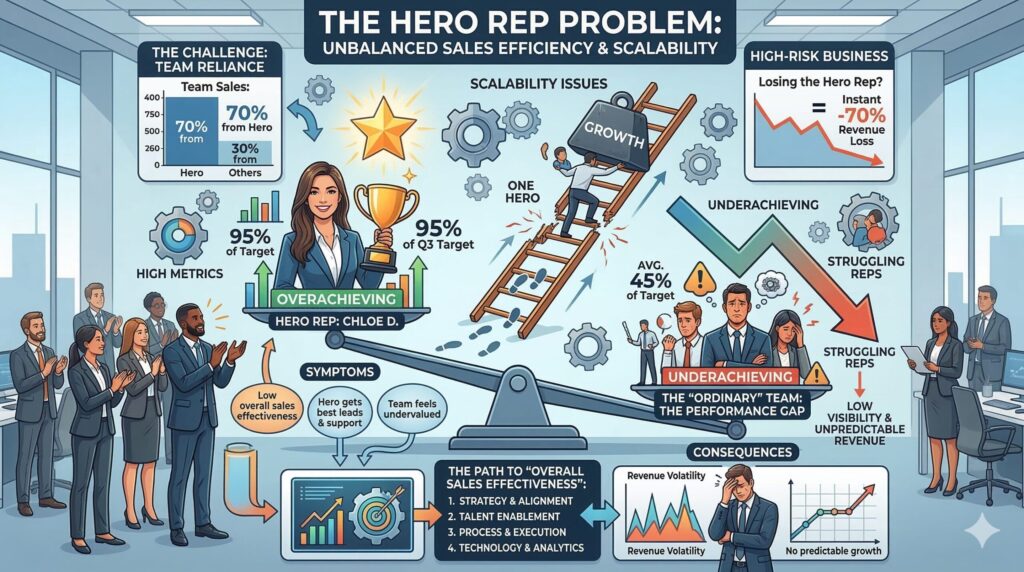
Many sales organizations depend heavily on a small number of high-performing salespeople. It is common for 20–30% of the sales team to generate the majority of revenue.
While top performers are valuable, relying on them creates risk. If one of these individuals leaves the company, retires, or changes roles, revenue can decline quickly.
Overall Sales Effectiveness focuses on creating a repeatable sales system that improves the performance of the entire team—especially the middle group of sales reps. When sales success is driven by a process rather than individual heroics, growth becomes far more scalable and stable.
Identifying Problems Before Revenue Declines
One of the greatest benefits of Overall Sales Effectiveness is its ability to act as an early warning system.
By monitoring key metrics such as pipeline coverage, win rates, deal progression, and sales cycle length, leadership can identify issues before they impact revenue.
For example:
- A decline in pipeline creation may signal future revenue shortfalls.
- Longer sales cycles may indicate problems with value messaging or buyer alignment.
- Deals stalled in late stages may reveal negotiation or approval barriers.
With the right metrics in place, CEOs can address problems months before they appear in financial results.
Aligning the Entire Organization Around Revenue
Sales effectiveness is not just a sales department issue. It requires alignment across the entire organization.
Marketing must generate qualified opportunities. Product teams must deliver solutions that create measurable value. Finance must ensure that pricing and margins support growth objectives. Sales leadership must ensure that opportunities move through the pipeline effectively.
Overall Sales Effectiveness provides a common set of metrics and insights that align these groups around one goal: converting market opportunity into profitable revenue.
Enabling Strategic Decision Making
CEOs make decisions every day about where to invest resources. Should the company hire more salespeople? Enter new markets? Expand product offerings?
Without clear sales effectiveness data, these decisions are based largely on assumptions.
With the right metrics in place, leadership can determine:
- Which markets produce the highest win rates
- Which products generate the most profitable deals
- Where sales cycles are slowing
- Where pipeline generation is strongest
This information allows CEOs to allocate resources where they will produce the greatest return.
The Bottom Line
B2B CEOs and owners should care about Overall Sales Effectiveness because it determines whether the company’s revenue growth is predictable, scalable, and sustainable.
Organizations that manage sales effectiveness well typically see improvements in win rates, pipeline conversion, and sales velocity—often producing 10–30% revenue improvement without increasing sales headcount.
But the true value goes beyond percentage increases.
Overall Sales Effectiveness transforms sales from an unpredictable activity into a repeatable revenue engine—one that leadership can measure, manage, and scale with confidence.
For CEOs responsible for driving growth, there are few capabilities more important.
Is your entire sales organization operating at a high level of Overall Sales Effectiveness? Click here to take a quick 12-question assessment and find out.